Many students with Learning Disabilities (LD) or Attention
Deficit Hyperactive Disorder (ADHD) have a difficult
time with long-term memory. This becomes very evident
in the area of Math. By the time they reach 5th or 6th
grade many still can't remember certain multiplication
facts.
I have been in classrooms as a behavior specialist observing
students display increasingly inappropriate behavior
in response to being forced once again to perform time
tests on their multiplication tables. I asked the teacher
why he felt they displayed these behaviors. His response
was that they didn't want to do the work. I agreed with
him. I then told him, "What if they just can't remember
their math facts?" He replied, "They must if they are
to be successful."
I disagree. I am one of those individuals who to this
day can't remember my 6, 7, 8, or 9 times table multiplication
facts. However, this does not mean we are dumb, lazy,
or unmotivated by any means. It just means that we need
a tool to help us. I have come up with a simple way to
do these math facts using finger math. With practice
it can be done quickly and privately. And I wish to emphasize
that counting on one's fingers is not a deficit but a
tool. I tell students if anyone makes fun of them or
tries to get them to stop, to respond by telling them
that it works for us; if they have a problem with it,
they can walk away.
Here are some photos with the explanation on how to
perform these simple calculations. I have had some teachers
say it is just too much to remember, but if you give
it some practice, you will be amazed. I have taught this
to hundreds of students and teachers with great success.
I have seen students learn how to use this tool and say, "Why
couldn't someone teach me this before?"
STEP 1
Each finger represents a number
The thumb on both fingers is 6
The pointer finger or the first
finger on both hands is 7
The next finger on the hand is
8
The ring finger is 9 on both hands
STEP 2
When a student needs to figure out a math fact that involves any one
of these numbers he places the finger on one hand which represents one
number against the finger on the other hand which would represent the
other number. It does not matter which number goes first as long as both
fingers that represent the numbers are pressed together. Here are some
photos to help you visualize the process.
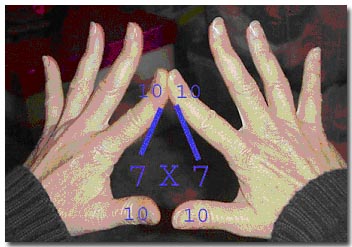
Here is the first example. The thumb on both fingers is 6
The pointer finger or the first finger on both hands is 7
The next finger on the hand is 8
The ring finger is 9 on both hands.
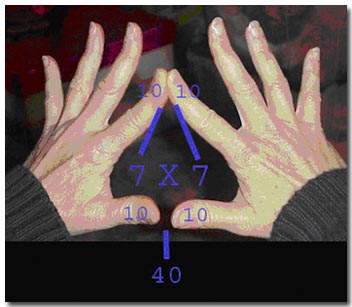
A student wants to figure out what 7 X 7 is. He takes the two
pointer fingers which represent 7 and presses them together.
All fingers including the ones that are pressed together represent
10 apiece.
In
this case you have the two pointer fingers and
the two thumbs for a total of four fingers or 40.
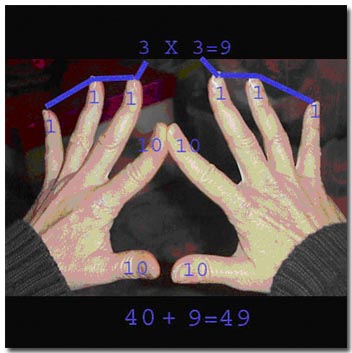
Now you figure in all the fingers behind or in back of the fingers
you have pressed together. Take the number of fingers on the
left hand which is 3 and multiply with the ones on the right
hand which is 3 and
3 X 3 = 9
so
40 + 9 = 49
7 X 7 = 49
Try it again with the middle finger which represents 8.
8 X 8
Press the two eight fingers together and count how many fingers
or 10s you have from those pressed together towards your body.
You should count 6 or 60. Then multiply the two fingers on each
hand behind the two pressed together and you get 4. So 8 X 8
is 64.
The only hard one is 6 X 6 because it is the thumbs and the
kids have to add 20 then multiply the balance of the fingers
on each hand which are 4 (4 X 4) and add to 20. They do get the
hang of it quickly.
Hang in there and try it because it really works.
Come across an outdated link?
Please visit The Wayback Machine to find what you are looking for.