Alice on the Web
Project URL:
http://teachersnetwork.org/teachnet-lab/meisler/alice/alice.htm
How it works:
As students go online and read Alice's Adventures in Wonderland and Through the Looking Glass and What Alice Saw
There by Lewis Carroll,
they accumulate written responses and creative writing pieces that
later become part of their own individual "Alice Books."
They read and do the written assignments as part of their Humanities
course. Chapters are read aloud in class and assigned for homework.
There is always a written component to the homework and some written
work is done in class as well. These assignments focus less on retelling
of events and more on personal and creative responses.In-class discussions center around the author's sense of humor
and his criticism of Victorian manners, and students are encouraged
to apply some of the techniques of satire, puns, and parody to create
their own episodes. They
craft their own accordion "Alice Books" in Art class using the
written responses and creative writing from their Humanities class,
and the books are then digitally photographed and archived on the
Internet.
Standards addressed:
Students use analytical thinking skills, become familiar with how actions
can demonstrate the personality traits of characters, and gain an
understanding of how an author's point of view is reflected in a work
of fiction. They make connections between what they read and aspects
of their own lives as well as the world around them. They examine
the language used to create humor and satire and they apply these
to their own writing. In creating visual representations of the text,
they find key details and evidence to show characters and plot.
Materials used:
Required
materials include computers with Internet access, a digital camera, notebooks
, glue
, markers
, scissors, and 8 1/2"
x 11" construction and white paper.
The students:
Alice on the Web is appropriate for 6th - 8th grade students at any level.
Overall value:
This unit links reading, writing, and art through a work of literature
that is accessible on the Internet. Students use their analytical
skills in reading a text, writing creatively, and creating visuals.
Humor is also seen as a well-crafted tool that students read and create
on their own.
Tips:
In
addition to their books, students can create another visual representation
of their reading experience for presentation to the class. They can make a diorama that depicts a scene or
create a sculpture or 3-D representation of a character
; work
together with one or two classmates to represent a scene with costumes
and scenery
; or try making a handmade book such as a single-stitch book or
a paper
bag book.
|
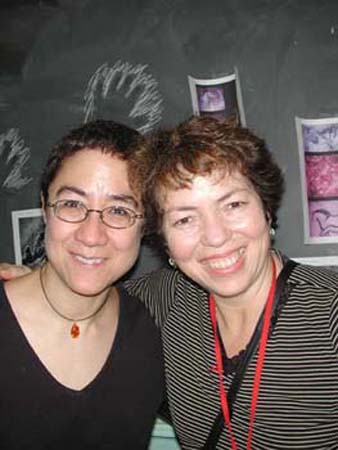
About the teachers:
Meryl Meisler and Grace Raffaele are colleagues working with
middle school students at the Institute for Collaborative Education
in New York City. Meryl teaches Art and Grace teaches Humanities.
They like to collaborate on units that involve both curricula.
E-mail:
mmeisl@nycboe.net
graceatice@nyc.rr.com
Subject Areas:
English Language Arts
Arts
Technology
Grade Levels:
6-8
|