Getting Started - Set Up an Effective ELL/ESL Classroom
Tobey
Bassoff
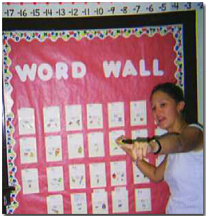 The primary goals of an ESL classroom are to make students feel accepted and
safe, while building their English language skills. To this end, I offer a few suggestions when building
your classroom to meet the needs of the ESL student: The primary goals of an ESL classroom are to make students feel accepted and
safe, while building their English language skills. To this end, I offer a few suggestions when building
your classroom to meet the needs of the ESL student:
1) Label everything. Print and laminate signs/labels for book boxes, pencil sharpeners, black boards, maps, globes, door, calendars,
etc. These labels will build your language learners essential classroom vocabulary.
2) Make Number Cards. Have your students make numeral cards numbered 1 - 20. Write the
word (eg. one) and have the students illustrate the card with a picture of one thing. You can
even use items around the classroom. Keep your eyes peeled for an ESL student who shows
a talent for drawing. It would be a wonderful way to draw them into the classroom
community. Continue your cards up to twenty. Now, when you are teaching math or having students read
directions with numbers, you have an automatic reference point. * Later, you can use these
cards as an early writing assignment. There are 5 blue boxes. There is one pencil sharpener.
3) Make signs that read: First, Second, Third, Fourth, Fifth, Sixth with the corresponding 1st,
2nd, 3rd. Students can use this to make Power Number Statements in their writing. For
example: Students should do their homework for three reasons: First, they have an
opportunity to practice what they learned in class.
4) Take pictures of your students and feature them on a board or a door. Have your students
faces, names, and something they like posted in your room. They will feel like they have a
place of their own in your classroom. They will also have a vested interest in learning how to
read, because everyone wants to read about themselves and other people they know!
Questions or comments? E-mail Tobey. |