About This Daily Classroom Special
Acadian Odyssey, created by Ron Dupuis, explores the culture of his ancestors by visiting "real" Cajun towns, presenting folk stories
and language, describing the unique Cajun way of cooking, and allowing web site visitors to experience numerous Cajun-related festivals in Southern Louisiana. Ron is a teacher at
Scotlandville Magnet High School in Baton Rouge (LA) and former Teachers Network web mentor.
Background
A special thanks to the Louisiana State University - Eunice for granting us permission
to use this page.
Mardi Gras in rural Southwestern Louisiana draws on traditions that are centuries old. Revelers go from house to house begging to obtain the ingredients for a communal meal. They
wear costumes that conceal their identity and that also parody the roles of those in authority. They escape from ordinary life partly through the alcohol many consume in their festive
quest, but even more through the roles they portray. As they act out their parts in a wild, gaudy pageant, they are escaping from routine existence, freed from the restraints that confine
them every other day in the year.
These traditions, folklorists say, go back at least as far as medieval times. The human impulse that underlies Mardi Gras has not diminished today, even if some of the traditions lapsed
for decades and even if one factor in their revival by subsequent generations was a desire to enhance tourism. Anyone who has seen the procession of Mardi Gras riders brightly costumed
in myriad colors advancing across the drab late-winter countryside is also likely to be swept up in the timeless moment: in rural Acadiana, Mardi Gras lives as much today as it did in
centuries past.
The Traditional Cajun Country Mardi Gras
According to folklorist Barry Ancelet in his excellent monograph "Capitaine, voyage ton flag":
The Traditional Cajun Country Mardi Gras, the Mardi Gras courir or run was found in most French sections of Louisiana in the nineteenth century. As they went from one household
to the next, the riders engaged in a rowdy celebration that, with the civilizing influences of the twentieth century, some towns decided to suppress. In the early 1950s, as part of
the effort by Paul Tate, Revon Reed, and others in Mamou to preserve Cajun culture, the Mardi Gras courir was revived. They also revived "La Chanson de Mardi Gras," a
song echoing medieval melodies still remembered by a few old-timers:
"Capitaine, Capitaine, voyage ton flag.
Allons se mettre dessus le chemin.
Capitaine, Capitaine, voyage ton flag.
Allons aller chez l'autre voisin."
|
"Captain, Captain, wave your flag.
Let's take to the road.
Captain, Captain, wave your flag.
Let's go to the other neighbors." |
The Tee-Mamou courir never lapsed, and the Eunice run was suspended only during World War II when many of the runners were in the service, but the revival of the runs in Mamou
and Church Point seems to have been a key development in the growing popularity of the courir. In 1968, Elton Richard of Church Point and State Senator Paul Tate of Mamou flipped
a coin determining that the Church Point run would be on Sunday and the Mamou run on Mardi Gras Day. As these runs grew in size and the run in Eunice also grew, other communities have
organized or revived runs.
The Captaine
In all of the Mardi Gras runs in rural Acadiana today, the capitaine, as the riders are known, maintains control over the Mardi Gras. He issues instructions to the riders as they assemble
early in the morning and then leads them on their run. When they arrive at a farm house, he obtains permission to enter private property, after which the riders may charge toward the
house, where the Mardi Gras sing, dance, and beg until the owner offers them an ingredient for a gumbo. Often, the owner will throw a live chicken into the air
that the Mardi Gras will chase, like football players trying to recover a fumble.
In addition to the Mardi Gras on horseback, some ride on flatbed trailers pulled by trucks or tractors. In the Tee-Mamou courir that goes through countryside where the farm houses
are widely separated, the Mardi Gras ride in a converted cattle trailer.
By mid to late afternoon, the courir returns to town and parades down the main street on the way to the location where the evening gumbo will be prepared.
Mardi Gras Costumes and Other Traditions
Mardi Gras wear all kinds of masks, including traditional masks that go back centuries: the high pointed conical hats or capuchons that parody the headdress of noble ladies and that are also
associated with dunces; masks with animal features, often with hair or fur; bishop's mitres parodying the clerical nobility; and mortarboards, which, since this mask makes fun of academics,
we at LSUE and Teachers Network will not include in the photographs below. ;-)
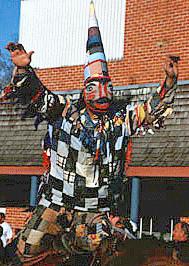
This rider in the Mamou courir has a capuchon and an animal mask. |
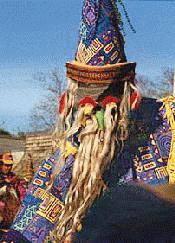 Notice the hair flowing around a beak in this mask, also in Mamou. Notice the hair flowing around a beak in this mask, also in Mamou. |
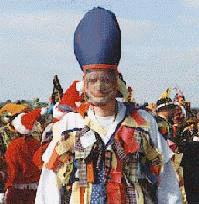
This mask, worn by a rider in the Eunice courir, parodies a bishop's mitre. |
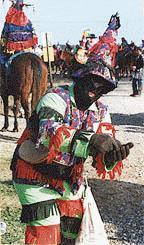
In earlier, more impoverished times, when the Mardi Gras re-enacted the medieval tradition of a procession of beggars, they might very well have needed help from farmers to get the ingredients
for their gumbo. Today, the Mardi Gras still carry on the tradition of begging. This Mardi Gras in the Eunice courir successfully begged for a quarter in exchange for posing for this
picture.
These Mardi Gras pages do not claim to be comprehensive, not even for the parishes covered by the Central Acadiana Gateway. A number of other communities have organized runs in addition
to the four runs included here (for example, Basile, Elton, L'Anse Meg, and Grand Prairie). Other towns have parades, Mardi Gras balls, and additional activities. Elsewhere in South Louisiana,
Mardi Gras in the City of Lafayette includes New Orleans-style parades. For schedules of events covering most towns and cities in South Louisiana, check out the Baton Rouge Advocate site
several weeks before Mardi Gras.
After Mardi Gras
The wild escape from the ordinary cares of life offered by Mardi Gras can only be understood in juxtaposition with Ash Wednesday and its reminder of earthly mortality. Lent is observed
by many Catholics in Acadiana with acts of penance or discipline in preparation for the celebration of Easter and its promise of spiritual immortality.
A Note on Source Material
In addition to his monograph "Capitain, voyage ton flag" (1989), published by the University of Southwestern Louisiana's Center for Louisiana Studies, Dr. Barry Ancelet covers
the same topics about Mardi Gras in Cajun Country (1991), coauthored by Jay Edwards and Glen Pitre and published by the University Press of Mississippi in its Folklife in the South Series.
Pat Mire's documentary film Dance for a Chicken: The Cajun Mardi Gras is an excellent account
of Mardi Gras in a number of Acadiana communities. LSUE's Folklore Series also contains information on Mardi Gras traditions (including new interviews on costumes and the Eunice courir in the
forthcoming third volume). For information, contact the LSUE Office of Grants and Assessment, (318) 457-7311, ext. 215.
Central Acadiana Gateway
LSUE Home Page