In
what ways other than DSTP scores can special education
students show growth in reading?
Summary
As
an advocate for special education students, I am
often frustrated that the progress of these students
in the classroom is being negated by their poor
Delaware State Testing Program (DSTP) scores. In
this time of high-stakes testing, special education
students often fall through the cracks. Some districts
in other states are looking into a value-added measure
that allows districts to examine the growth of students
over time through a statistical approach. Granted,
the mathematical analysis may vary a little from
state to state, but this is a way to corroborate
data including, but not exclusive to, the high-stakes
state test.
Through
this research, I simply wanted to explore alternate
routes to show growth in special education students.
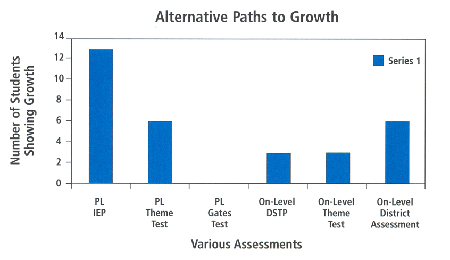
As a result, I found district and classroom assessments
that display performance-level and on-level growth.
I also examined IEP objectives in reading to determine
growth of these students. In addition, two students
put together portfolios to showcase their progress
in reading.
What
I found was that many of these students do not show
growth on the DSTP yet show growth on the district
and classroom assessments. Since many of these tests
are required throughout the district, isn’t it then
feasible to document growth over time and develop
some statistical measure to use as a value-added
approach? Any growth should be celebrated, not undermined
by the performance on one high-stakes test.
Although
there was not as much growth as I would have liked
to see, I am able to determine strengths and weaknesses
with my teaching and the curriculum. Through this
study, I was able to examine the real effectiveness
of what takes place in the classroom.
RECOMMENDATIONS
On a
federal level, the No Child Left Behind mandate
should be modified to allow for statewide measuring
methods for learning among special education students.
On a
state level, policy makers should create and adopt
alternate forms of measuring growth within a diverse
range of ability levels among special needs students.
Special
education teachers should be given the latitude
to use specific measures to determine growth among
their students.
|