

How Perceptions Were Changed in New York7 Comments
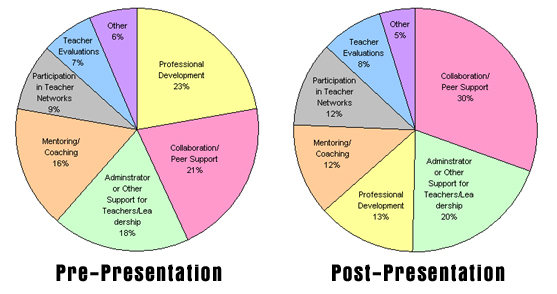
At our May 6, 2010 Convening—Expanding the Conversation about Teaching: What Will it Really Take to Make Sure Every Child has an Effective Teacher?—we asked participants to rank the importance of six supports that are most needed in order to improve teacher effectiveness: Professional Development; Collaboration/Peer Support; Teacher Evaluations; Administrator or other Support for Teachers/Leadership; Participation in Teacher Networks; and Mentoring/Coaching.
Among meeting attendees, the three most important supports – both before and after the meeting – were: Professional Development; Collaboration/Peer Support; and Administrator or other Support for Teachers/Leadership. However, after hearing from our researchers, panelists and keynote speaker, the relative importance among these three categories changed. At the beginning of the day, most people believed that Professional Development was most important, with Collaboration/Peer Support a close second and Administrator or other Support for Teachers/Leadership not far behind. By the end of the day, Collaboration/Peer Support was considered, by far, the most important support needed in order to improve teacher effectiveness. Administrator or other Support for Teachers/Leadership had moved to second place with Professional Development now third, on par with Participation in Teacher Networks and Mentoring/Coaching.
What do you think is most needed in order to improve teacher effectiveness?
Over and over, participants noted the importance of collaboration. Here are some quotes from convening attendees:
- “It has reinforced my conviction that building professional/collaborative learning communities are crucially important,”—College Teacher, Researcher.
- “I was surprised to see how important collaboration can be to retention. The interdisciplinary approach can be very powerful.”—Publisher.
- “Collaboration and networking is necessary and developing good teachinginvolves a leader who understands teaching and builds structures to support teacher development.”—Non-profit/Foundation Associate.
The need for structures and supports was repeated throughout the day. Researchers, Dr. Barnett Berry and Dr. Ken Futernick, presented compelling evidence that the key to improving our schools is having structures in place that identify and support effective teaching. This “systems approach,” including how administrators can best support and evaluate teachers, was echoed in the participant responses:
- “I think we need to reframe the discussion to be about effective teachingas opposed to effective teachers.”—Teacher, K-12
- “Panelists and researchers got me to give greater emphasis to structures and policies throughout the system that support teacher learning and collaborative planning.”—Non-profit/Foundation Associate
- “Thank goodness researchers are now working on better assessments/evaluations. Otherwise we get these ridiculous statements about 1) how many effective teachers there are, and 2) how few effective teachers there are. Who knows really, without a clear definition of effectiveness!” —College Teacher/Researcher
We would like to hear from you. What structures or supports do you think are most needed in order to improve teaching effectiveness?



Comments
The notion that a teacher is only accountable to an administrator, and not parents and students, is a little counter-intuitive, and the idea that an administrator is accountable only to the principal -- also counter-intuitive since, as far as I can see, and administrator role SHOULD be a lead-teacher role.
I think that students at the very least should have a say in their teachers' yearly rating, and teachers should definitely have a say in their administrators' and principal's rating for the year
again, this idea is steering the focus to the system and structure, and away from the lone teacher mentioned in a prior post
I don't think many administrators are able to be good teacher leaders. In NYC, they do not have to be master teachers -- some have only taught for four years -- or never! So, really, it's the practitioners in the classroom who should be empowered to lead pedagogy workshops. Some of my best PD has been through simple classroom observation and lesson-plan swapping with colleagues.
Doctors need a(n) MD in order to practice medicine. Lawyers need a JD in order to practice law. What about teachers? Is it fair for our students to go into today's classrooms with teachers who aren't prepared?
In an Edutopia article on Teaching Preparation (http://edutopia.org/linda-darling-hammond-teacher-preparation), Linda Darling-Hammond, an expert on education, writes,
"In the last ten years there's been a lot of research done about what makes a difference for student achievement, and it's now clear that the single most important determinant of what students learn is what their teachers know. Teacher qualifications, teacher's knowledge and skills, make more difference for student learning than any other single factor."
She also writes,
"An interesting and little-known fact is that the better prepared teachers are, the longer they're likely to stay in teaching and the more likely they are actually to enter teaching. So, teachers who are coming through these new five-year teacher-education models that give a bachelor's degree in a content area, plus a master's in teaching and a full year of student teaching are very rigorous and very tightly coupled, often with the training in a professional development school. A very high rate of these folks go into teaching and stay. Usually, more than 90 percent enter the profession, and of those, about 90 percent are still there several years later.
Those who come through the shorter summertime "learn-to-teach" routes leave at much higher rates -- for example, 70 percent are gone within three years -- that it's actually less expensive to train a teacher more thoroughly on the front end than it is to continually replace teachers who come in and out with very little preparation. The reason is kind of obvious for anyone who's been in classrooms for any length of time: Teaching is really hard."
-Renny, Educator, NYC
In addition, the review system we have now in New York is so limited to be useless and almost offensive to teachers who try. I am either satisfactory or unsatisfactory. With the amount of time I spend preparing, grading, emailing and calling parents, posting assignments and comments on a website, designing engaging activities and meeting with students one-on-one I think I deserve to be MORE than satisfactory. That doesn't reflect the work I do or my training and professional development.
I know that there has been talk of a four "grade" rating system coming to NYC. I don't think it can come quickly enough. It will change teaching for the better. I think teachers (who do not already do this) will strive for a better review and it will foster healthy competition. And this is just a stepping stone to a larger change in the way we assess teachers. Although I know that the current system was made to protect teachers I think it hurts teachers and kids, too. Satisfactory is not good.