Charts in the Classroom (A Pictorial View) by Julia Millin
Using charts in the early childhood classroom helps to create a print rich environment. Charts can be used to foster independence in students’ reading and writing skills. Charts can be created prior to a lesson, but most charts are created with the students during the lesson or during reading and writing workshop. They should be visibly displayed for students to use as a reference tool.
|
|
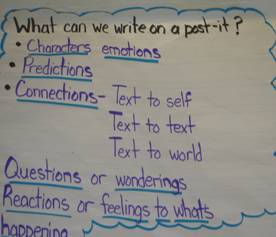
Using a Post-it
During a reading workshop mini lesson, second grade students learn how to use post-it notes to keep track of their reading. |
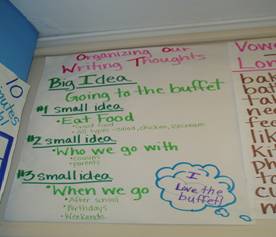
Organizing Writing
Second graders learn how to organize their writing. |
 |
|
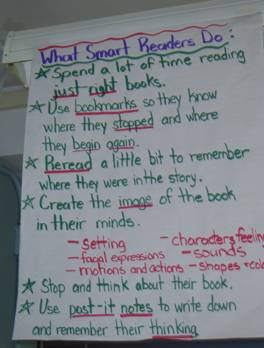
What Smart Readers Do
During a mini lesson, second grade students were asked, “What do good readers do?” The teacher lists some of their responses on a chart, then reconstructs the chart to present it in an organized manner. |
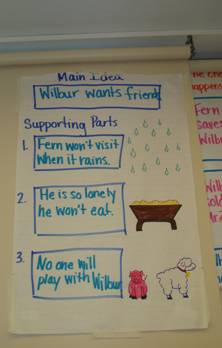
The Main Idea
This chart was created after a read aloud. Students listened to a chapter from E.B. White’s Charlotte’s Web. They were then asked to identify the main idea of the chapter and parts that support the main idea. |
 |
|
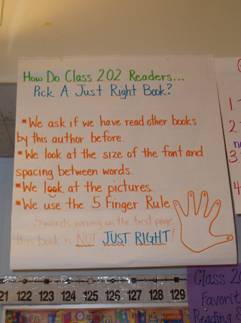
Choosing a Just Right Book
This chart was created to remind students how to choose a just right book. |
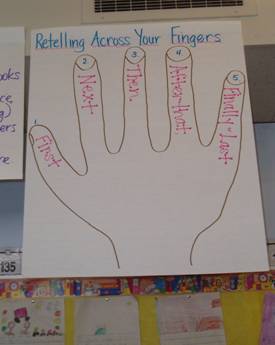
Retelling a Story
Students learn to retell a story across their fingers by using cue words such as, first, then, next, after that, and finally. |
Charts should be colorful and attractive. Refer to the charts when revisiting a strategy, conferring with students, or modeling using resources in the classroom.
Do you have a question or comment about this article? E-mail Julia.
|